Quick answer
- Create a location page only if you can offer unique, useful information for that area.
- Near-identical pages with only place names changed breach Google’s spam policies.
- Strong pages include local evidence: projects, team, travel details, partners and customer questions.
- Link location pages to the main service page and avoid competing for the same query.
What location pages are and when they work
Location landing pages describe your services for a specific place, whether a branch, a service area or a neighbourhood. They work when searchers use place-specific queries and when the business has something real to say about that place. A plumber with a team based in one borough, a clinic with a branch in another, or a firm with notable projects in a district all have genuine reasons for separate pages.
They do not work when the only difference between pages is the name of the place. That approach produces what Google calls doorway pages, and it can lead to demotion.
Why many London location pages fail
London’s many boroughs and neighbourhoods tempt businesses to create dozens of near-identical pages. Search engines recognise the pattern and either ignore the pages or classify them as spam. These pages also compete with each other and with the main service page, a form of cannibalisation explained in keyword cannibalisation.
Our rule is simple: if a page would be useless to a visitor from that area, or you cannot support it with real local evidence, do not create it.
Test: is a location page justified?
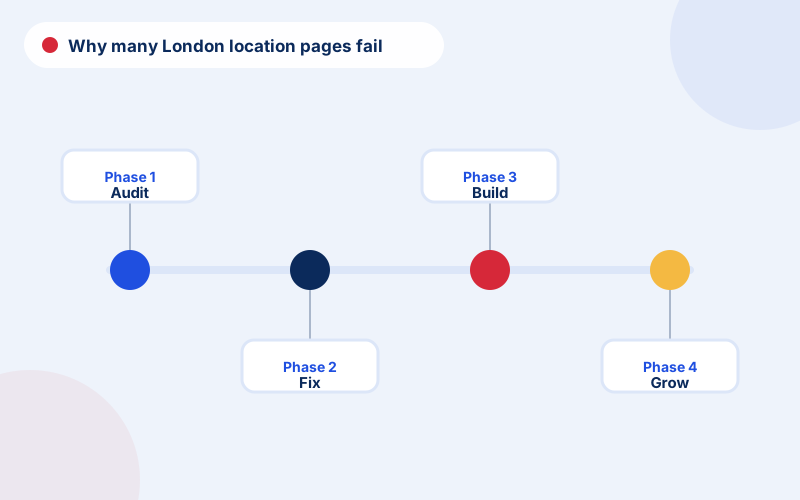
Answer these questions before creating an SEO location page.
| Question | If yes | If no |
|---|---|---|
| Do you have a branch, team or regular presence there? | Strong case for a page | Consider a general service-area section |
| Is there search demand for the place plus service? | Page may help | Do not create the page |
| Can you show local projects, customers or examples? | Include them as evidence | Hold off until you can |
| Is the offer or pricing different there? | Explain the differences | One page may be enough |
What makes unique location page content
Unique content is about information, not rewording. Useful additions include local project examples, photos, testimonials from customers in the area, details of access and travel, local regulations or conditions that affect the service, team members who work there, and answers to questions customers in that place actually ask. Embed a map only if it helps visitors.
Aim for pages that you could confidently show to a customer in that place as the best explanation of how you serve them.
Structure and internal linking
Build a clear hierarchy: a main service page, supported by a small number of well-developed location pages. Link location pages up to the main service and across to relevant siblings where it helps. Use consistent naming, include the location in the title and heading naturally, and avoid repeating the same exact phrase. Our guide to website architecture and internal linking covers the structure.
Multi-location businesses and service-area businesses
Businesses with several physical locations should have one page per location, each tied to its own Google Business Profile with matching details. Service-area businesses without public premises should be cautious: consider one strong page describing the areas served, supplemented by case studies from specific places, rather than a page for every postcode. See Google Business Profile optimisation for how profiles and pages should align.
SEO location pages, service area pages and local landing pages
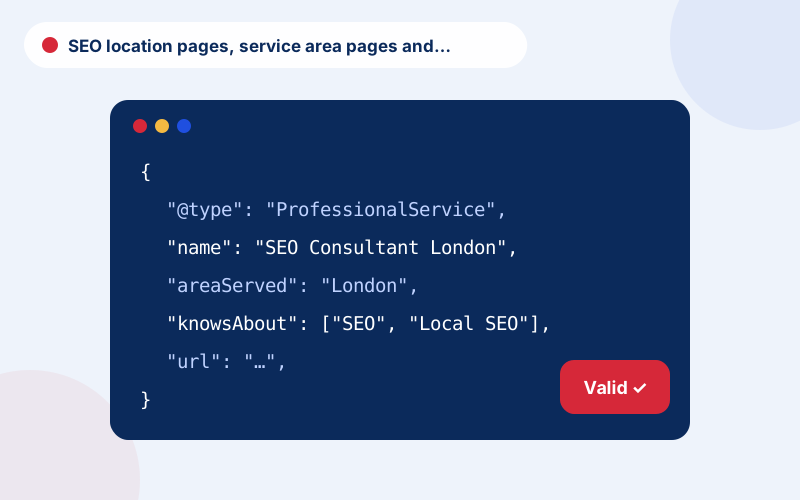
Terms vary, so here is how we use them. SEO location pages and location page SEO describe pages built for a specific place. Service area pages SEO refers to pages that describe where a mobile business works. Local landing pages is the broader term, covering any page built for a local search. Multi location SEO pages are location pages for a business with several branches, each with its own profile and team.
Whatever name you use, the test is the same: does this page help someone in that place more than your main service page does? If not, do not create it.
Avoid keyword cannibalization in location pages
To avoid keyword cannibalization in location pages, give each page a distinct purpose, link them to the main service page and avoid targeting the same phrase on several URLs. Unique location page content, such as local projects, local team members and local questions, differentiates pages and gives users a reason to read them. Check Search Console after publishing to see whether pages compete, and merge any that do.
A worked example of deciding on a location page
Suppose a London electrician has a team based in two boroughs and regularly works in six more. The two base boroughs justify pages with real information: team members, typical jobs, local landlords and housing stock, and recent reviews. The six others are better served by a single service area page that lists them, supported by case studies that name the areas where jobs were completed. This approach gives genuine depth where it exists and avoids thin duplicates elsewhere.
Getting a location strategy right
A good local plan decides which locations deserve pages and what each should contain. We include this in our local SEO consultant work, and the research behind it comes from the keyword mapping in keyword research and intent-to-URL mapping. For a broader look at our offer, visit SEO consultant London.
Frequently asked questions
Do I need a page for every London borough?
No. Create pages only where you have real local presence or evidence and the search demand justifies it.
Are location pages doorway pages?
They become doorway pages when they are near-identical and exist only to rank for place names. Genuinely useful, distinct pages are fine.
How long should a location page be?
Long enough to answer local customers’ questions with unique evidence. Quality and distinctness matter more than word count.
Should location pages link to each other?
Link them to the main service page and to genuinely related pages, but avoid large lists of every location in the footer.
What about service-area businesses with no premises?
Use a well-developed service area page and local case studies instead of creating many thin pages.
Talk to an SEO consultant
Questions about this topic or your own site? Send a few details and you will get a clear, practical reply.