Quick answer
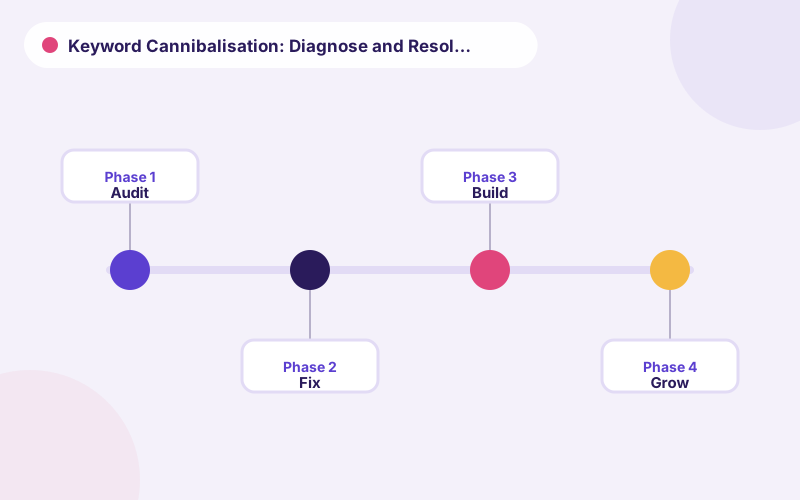
- Cannibalisation is a problem only when pages serve the same intent and split signals.
- Find it by checking which URLs get impressions for the same query in Search Console.
- Fix by merging, re-targeting, adjusting internal links or using a redirect.
- Prevent it with a keyword map that gives each search task one owner.
What keyword cannibalisation really is
Keyword cannibalization, spelled cannibalisation in UK English, describes pages on the same site competing for the same query. When Google has several similar candidates, it may alternate between them, rank a weaker one, or push all of them lower than a single consolidated page would rank. Links, content and engagement signals get spread across duplicates instead of building on one URL.
It is not simply two pages appearing for one query. A homepage and a service page can both appear for a brand search without harm. The issue arises when the pages do the same job.
How to tell if pages compete
Cannibalisation is a search intent overlap question. Ask whether a searcher for this query would be equally well served by either page. If a guide and a service page both target “local seo”, the results may differ in format, and Google might correctly show different pages for different intents. If two guides explain the same thing in slightly different words, they are competing.
Check the live results too. If the pages Google shows for the query are all of one type, and you have two of that type, you probably have an overlap.
How to find keyword cannibalisation in Search Console
Use the Performance report to look at query and page relationships.
- Open Performance and choose a date range of at least three months.
- Filter by a query you suspect is affected.
- Switch to the Pages tab to see which URLs get impressions and clicks.
- Look for several URLs with meaningful impressions for the same query.
- Check whether the leading URL changes over time, which suggests Google is unsure.
- Export data to a spreadsheet to find patterns across many queries.
Deciding what to do about overlap
Match the fix to the situation.
| Situation | Recommended action |
|---|---|
| Two pages with the same intent and similar content | Merge into the stronger page and 301 redirect the other |
| Pages with different intents but overlapping wording | Differentiate titles, headings and focus; adjust internal links |
| A weaker page outranks the preferred one | Strengthen the preferred page and link to it with clear anchors |
| Old, thin or outdated duplicate | Remove or redirect it |
How to fix cannibalisation step by step
To fix keyword cannibalisation, first choose the page that should own the search task, usually the one with the best content, links and conversions. Move any valuable content from the other page into it, then redirect the old URL with a 301, updating internal links to point at the winner. If both pages must remain, rewrite titles and headings to focus on distinct tasks and remove contradictory internal anchors.
After changes, monitor impressions and positions for several weeks. Consolidation sometimes causes a temporary dip before a stronger result appears. For redirect practice, read 301 redirects and redirect mapping.
A keyword cannibalisation audit routine
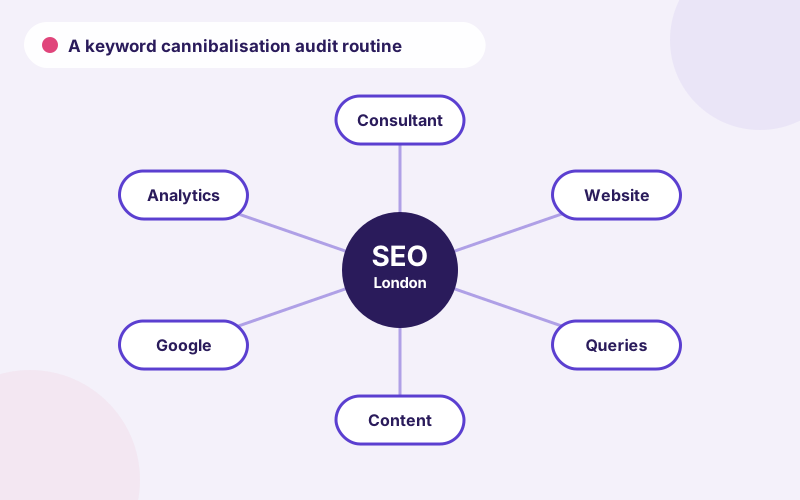
Run a lightweight audit twice a year. Export queries and pages from Search Console, group by query, and flag those with multiple URLs. Cross-check with your keyword map and review the flagged pairs manually. Content consolidation for cannibalisation is often one of the highest-return tasks, and it is covered within our content refresh and consolidation guide.
Keyword cannibalisation SEO: Search Console and content causes
Keyword cannibalisation SEO issues most often come from content cannibalisation: several posts written at different times on the same subject. Competing pages same keyword situations are easy to see in Search Console when you filter by query and view the Pages tab. Keyword cannibalisation Search Console checks should be part of every quarterly review.
For how to fix keyword cannibalisation quickly: choose the winner, merge the best content into it, redirect the others, update internal links and monitor for a few weeks. Where two pages truly serve different purposes, change their titles and headings so the difference is obvious to both users and Google.
A worked example of resolving overlap
Imagine two guides, “local SEO tips” and “how to improve local SEO”, both receiving impressions for the same queries. The first has more backlinks, the second is more thorough. The decision is to merge the best sections of the second into the first, update the title to cover both, redirect the second URL with a 301 and update internal links. After a few weeks Search Console shows one URL receiving the combined impressions, usually with a better average position than either had alone.
Preventing overlap in the first place
Prevention is cheaper than cure. Maintain a keyword-to-URL map, as described in keyword research and intent-to-URL mapping, and check it before commissioning any new page. This is a core part of our SEO content strategy work, and a full review of overlap is included in our SEO audit. For the wider service overview, see SEO consultant London.
Frequently asked questions
What is keyword cannibalisation?
It is when multiple pages on one site compete for the same search task, splitting signals and often lowering performance for all of them.
Is it always bad to have two pages ranking for one keyword?
No. If the pages serve different intents or one is a brand result, it can be fine. It is a problem when they do the same job.
How do I fix keyword cannibalisation?
Merge and redirect duplicates, differentiate pages with distinct intents, adjust internal links and update titles and headings.
Can I use canonical tags instead of merging?
Sometimes, but if the content is the same and one page is unnecessary, a merge and 301 redirect is usually cleaner.
How long does it take to see improvement?
Often several weeks after Google reprocesses the changes. Monitor Search Console for the shift.
Talk to an SEO consultant
Questions about this topic or your own site? Send a few details and you will get a clear, practical reply.