Quick answer
- A topical map organises a subject into pages with clear jobs, relationships and priorities.
- Start with your source context, the real business that provides the answers, and a central entity.
- Map the attributes and questions around the entity, then group them into core and outer sections.
- Each page owns one search task, and contextual links connect related topics.
What a topical map is and why it matters
A topical authority map lays out every subject your site should address, how the subjects relate and which page owns each one. Search engines assess whether a site covers a topic with depth and coherence, and AI answer systems prefer sources that treat a subject consistently. Topical mapping SEO provides a deliberate structure instead of an accidental pile of posts.
The map is a working document. It guides what to write, what to merge and in which order to publish, and it can be reviewed against actual search performance.
Step 1: define the source context and central entity
The source context is the real-world nature of the business: what it sells, to whom and how it makes money. The central entity is the main subject the site is about. For this website, the central entity is search engine optimisation, qualified by consultancy and London. Choosing them carefully keeps the map focused, since every topic should connect back to them.
This is the logic behind what semantic SEO practitioners call the central entity and central search intent: what the site is fundamentally about and what the typical visitor wants to achieve. Write both as single sentences before you start listing pages.
Step 2: map entities, attributes and relationships
List the entities connected to your central entity and the attributes of each. For an SEO consultancy those might include audits, technical SEO, local profiles, content and reporting, with attributes such as scope, cost, process and results. Entity attribute mapping turns a vague subject into specific page candidates: each meaningful attribute or relationship can justify a page or a section.
Include relationships too: how crawling affects indexing, how reviews affect local rankings, how migrations affect redirects. Relationships often become the most useful explanatory pages.
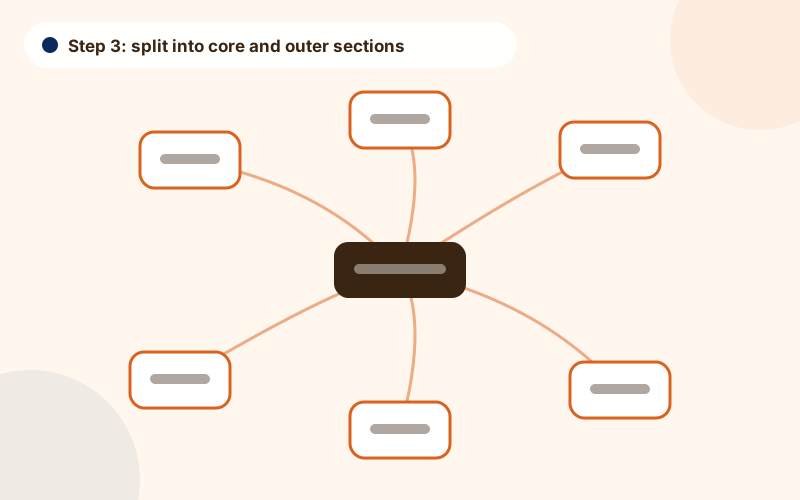
Step 3: split into core and outer sections
Separating commercial content from supporting knowledge keeps the map clear.
| Section | Purpose | Examples for a service business |
|---|---|---|
| Core | Pages that sell or decide: services, process, pricing, proof | SEO audit, technical SEO, pricing, case studies |
| Outer | Pages that educate and diagnose, linking to the core | Guides on indexing, canonicals, reviews, reporting |
Step 4: assign queries and intents to pages
For each topic, choose the primary query and supporting phrases, and decide the page type from search intent. Use the process in keyword research and intent-to-URL mapping and the intent types in search intent for service business content. Make sure no two pages share the same primary task. Where topics are too thin to justify a separate page, merge them into a section of a stronger page.
Step 5: define contextual bridges and internal links
Contextual bridges are links placed where a reader’s question naturally leads to a related topic or service. A guide about crawling problems should link to technical SEO help at the point the reader realises they need it, with anchor text that explains the connection. Plan these links in the map, noting the source, destination and purpose, and follow the principles in website architecture and internal linking.
Semantic SEO topical map terms explained
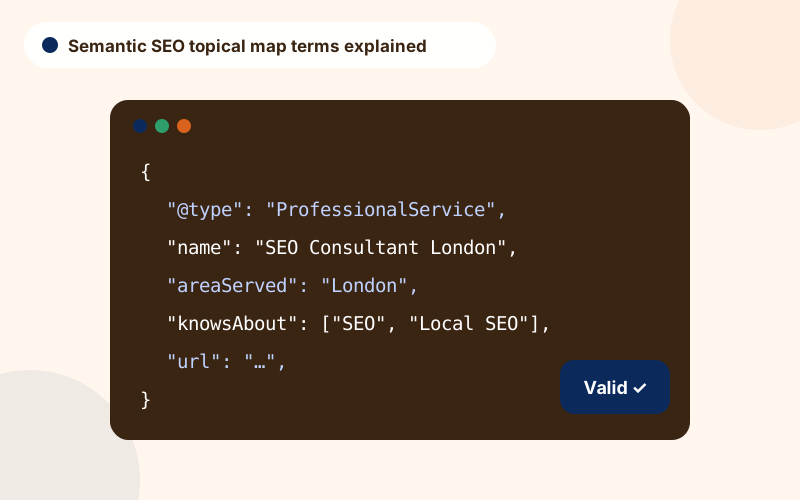
Readers meet several terms around the idea of a semantic SEO topical map. A core and outer topical map divides pages into commercial and supporting groups, as described above. Source context SEO is the practice of writing from the position of the business that actually provides the answers. Central entity SEO focuses the site on one main subject, while a semantic content network describes how connected pages share entities, attributes and links.
These labels come from semantic SEO practice and are applied here as a working method rather than a formal standard. They are useful because they force clear decisions: what is this site about, who is it for and what should each page do.
Common topical mapping mistakes
Common mistakes include building a map from a keyword tool alone, creating pages for every minor variation and neglecting the commercial core. Another is publishing outer content that never links to a service. Avoid these by starting from the business, limiting pages to distinct tasks and writing contextual links into every brief.
Step 6: prioritise, publish and review
Do not publish everything at once. Prioritise foundation pages that carry revenue, then depth pages that support them, and finally selective expansion where demand and capability are proven. Review the map after each phase using Search Console, and prune or merge pages that do not earn their place, using the approach in refresh, merge or remove content. Our SEO content strategy service builds and maintains maps like this, and you can see the full offer on SEO consultant London.
Frequently asked questions
What is a topical map in SEO?
It is a structured plan of the topics, questions and pages needed to cover a subject thoroughly and connect it to your services.
What is the difference between core and outer sections?
Core pages carry commercial intent, such as services and pricing. Outer pages educate and diagnose, building trust and linking to the core.
How many pages should a topical map include?
As many as the subject needs and your business can support well. Quality and distinct purpose matter more than volume.
Do I need special tools?
No. A spreadsheet and live search results are enough. Tools can help with research and clustering.
How often should I update a topical map?
Review it after each publishing phase and at least quarterly, using performance data.
Talk to an SEO consultant
Questions about this topic or your own site? Send a few details and you will get a clear, practical reply.
Related pages
- SEO Content StrategyAn SEO content strategy consultant to map topics, search intent and briefs to your business …
- SEO Guides for Business OwnersPractical SEO guides for business owners: audits, technical SEO, local SEO, content, ecommer…
- Keyword Research and Intent-to-URL MappingA keyword mapping process for service businesses: group searches by task, assign one URL per…