Quick answer
- Use hreflang when you have equivalent pages for different languages or regions.
- Every page must reference all alternates including itself, and each alternate must link back.
- Hreflang URLs should be canonical, indexable and return a 200 status.
- Choose URL structure, folders, subdomains or country domains, before implementing.
When hreflang is relevant
Hreflang tags matter when you publish the same or very similar content for different languages or countries, such as English pages for the UK and the US, or a site in English and German. They help Google serve the right version to each user and reduce the chance that one regional page is treated as a duplicate of another. They do not boost rankings by themselves and are not needed for a single-language, single-country site.
They are also a signal rather than a directive. Google combines hreflang with other signals, such as content language and links, when deciding which URL to show.
Hreflang syntax and examples
The attribute value combines a language code in ISO 639-1 format and optionally a region code in ISO 3166-1 Alpha 2 format, such as en-gb or de-de. In HTML it looks like <link rel="alternate" hreflang="en-gb" href="https://example.com/uk/">. You can also use HTTP headers for non-HTML files or XML sitemaps for large sites. Choose one method and keep it consistent.
Remember that region codes are for countries, not languages: en-uk is incorrect, and the correct code is en-gb.
Return tags and x-default
Reciprocation is the rule that most implementations get wrong.
- Each page must list itself and every alternate version
- If page A points to page B, page B must point back to page A
- Use x-default for a fallback page, such as a language selector or global version
- Alternate URLs must be indexable and not redirected or blocked
- Annotations must be consistent across HTML, headers and sitemaps if more than one is used
Hreflang and canonical tags together
Each language version should have a self-referencing canonical tag, pointing to itself, not to another language version. Canonicalising all versions to one URL tells Google to ignore the others, defeating hreflang. When canonical and hreflang conflict, Google may disregard the hreflang. See canonical tags and duplicate URLs for the underlying rules.
International URL structure options
Pick the structure that fits resources and goals.
| Structure | Example | Pros | Cons |
|---|---|---|---|
| Subfolder | example.com/fr/ | Shared authority, easier management | Weaker geographic signal than a country domain |
| Subdomain | fr.example.com | Separate hosting possible | May be treated as a separate site |
| Country domain | example.fr | Strongest local signal and trust | Costly and builds authority separately |
How to validate hreflang
Crawl the site with a tool that checks hreflang, looking for missing return links, invalid codes, non-canonical targets and redirected or broken alternates. Test sample URLs manually, and use Search Console performance filtered by country to confirm the right pages appear in each market. Re-check after migrations and template changes, since hreflang often breaks silently.
Hreflang examples, return tags and x-default
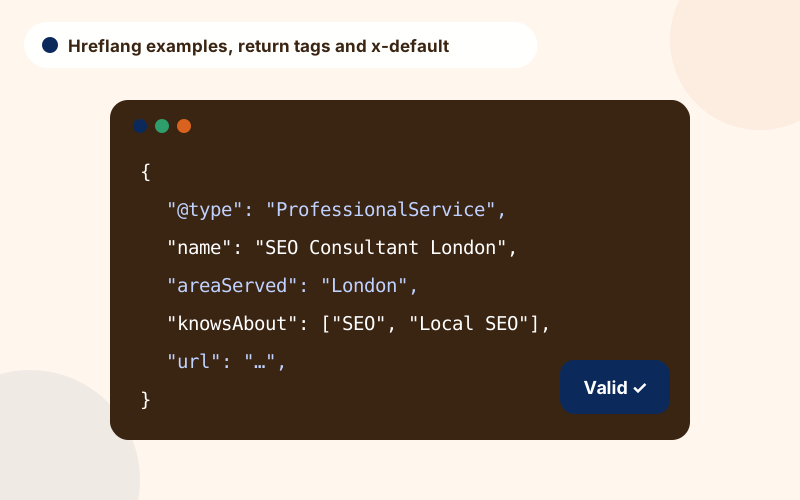
Useful hreflang examples are en-gb for English in the United Kingdom, en-us for the United States and de-de for German in Germany. Hreflang return tags confirm that each page references the other, and x default hreflang points to a fallback page. If hreflang canonical tags conflict, Google may ignore the annotations, so keep each version’s canonical pointing at itself.
Hreflang validation should include checks for language codes, reciprocal links, indexable targets and consistent methods. Run it on a sample first, then on the whole site.
Multilingual URL structure and country targeting
A multilingual URL structure should be predictable: the same path after the language folder on every version, where content allows. International SEO URL structure choices influence hosting, authority and maintenance, as described above. Country targeting SEO relies on several signals together, including hreflang, content, currency and links. Language and region targeting is easiest when your business operations also reflect the markets you target, with local delivery, support and pricing.
Common hreflang mistakes
The usual mistakes are missing return links, using wrong or invented codes such as en-uk, pointing to redirected or noindexed URLs, and mixing methods that disagree. Other issues include forgetting self-references and using hreflang for pages that are not equivalents. Fix these by choosing one implementation method, validating on a sample and then at scale, and re-checking after releases.
Remember also that hreflang does not replace good localisation: if the content does not fit the market, no annotation will make it perform.
A worked example for a UK and Irish site
Suppose a retailer has /uk/ and /ie/ folders with similar English content but different currency and delivery. Each page lists three annotations: en-gb for the UK version, en-ie for the Irish version and x-default pointing to the UK page. Each version has a self-referencing canonical. We would crawl to confirm the return links, then check Search Console to see that Irish users are shown the Irish pages. Small, careful steps like these prevent most hreflang problems.
Planning an international structure
Decide markets, languages and structure first, then implement hreflang and localised content together. Our international SEO consultant service helps choose and validate the approach, and migrations to new structures are covered by SEO migration consultant support. To see our full range of services visit SEO consultant London.
Frequently asked questions
What is hreflang?
Hreflang is an annotation that tells search engines which language or regional version of a page to serve to which users.
Do I need hreflang for UK and US English?
If you have separate, similar pages for each market, yes. It helps Google show the correct version.
What is x-default?
It is a hreflang value that specifies a fallback page for users whose language or region does not match any listed version.
Can hreflang be used with a single language?
It is unnecessary for single-language, single-country sites.
Why is Google ignoring my hreflang?
Common causes are missing return links, wrong codes, non-canonical or redirected targets and conflicts with canonical tags.
Talk to an SEO consultant
Questions about this topic or your own site? Send a few details and you will get a clear, practical reply.